Condition Focus: Lymphedema — Clinical Evidence for Volume Reduction
While the preclinical lymphatic studies demonstrate mechanism, this systematic review in BMC Cancer provides the clinical evidence: PBM reduces lymphedema volume and improves function in human patients. Analysing 8 randomised controlled trials of PBM for breast cancer-related lymphedema, the review confirmed consistent volume reduction and functional improvement across studies.
The included trials used wavelengths spanning 650–1000 nm and demonstrated that PBM restores lymphatic vessel function, prevents tissue stiffness, and modulates fibroblast and lymphocyte activity at the tissue level. The 93% positive response rate — with patients experiencing 16–22% volume reduction in affected limbs — provides compelling evidence that PBM’s lymphatic effects translate to measurable clinical outcomes.
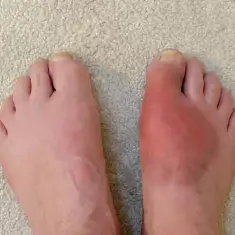
For gout, the lymphedema evidence translates through shared mechanism rather than shared diagnosis. Both conditions involve fluid accumulation in tissue, impaired lymphatic drainage, and the need for enhanced clearance of waste products. In gout, the “waste” includes dissolved urate, inflammatory debris, dead neutrophils, and cytokine-rich exudate from the flare. Efficient lymphatic clearance of these materials is essential for flare resolution and for preventing the chronic inflammatory environment that promotes tophi formation.
The clinical RCT evidence also addresses a practical concern: do the preclinical lymphatic findings translate to real-world volume reduction in humans? This review confirms that they do.
G.O.A.T. for Gout Alignment:
The 650–1000 nm wavelength range used across these trials encompasses the G.O.A.T.’s 660 nm + 850 nm output. The volume reduction and lymphatic restoration demonstrated clinically support the G.O.A.T.’s potential for reducing joint swelling and enhancing waste clearance in gout.
Link to original research here
Editor’s note: The preclinical lymphatic mechanism behind these clinical results is demonstrated in PBM Lymphatic Contractility 2020. The broader clearance principle via the glymphatic system is reviewed in Salehpour et al 2022. The joint swelling reduction measured by bioimpedance is demonstrated in Chia et al 2025. The vascular perfusion improvement that complements lymphatic drainage is confirmed in Gavish et al 2020.
Related Articles
- PBM Stimulates Lymphatic Contractility and Flow – 2020
- PBM and the Glymphatic System: Augmenting Lymphatic Drainage – Salehpour et al 2022
- PBM on Swelling Reduction and Recovery in TKA – Chia et al 2025
- Microcirculatory Response to PBM: RCT – Gavish et al 2020
- PBM on RA and OA: Edema and Vascular Permeability – Fonseca et al 2025
Key Takeaways
- 8 RCTs confirm PBM reduces lymphedema volume by 16–22% in 93% of patients
- Lymphatic vessel function restored — not just symptom masking
- 650–1000 nm wavelength range encompasses G.O.A.T.’s 660 nm + 850 nm
- Clinical proof that preclinical lymphatic findings translate to human outcomes
Study Overview
| Study Type: | Systematic review (8 RCTs) |
| Wavelength(s): | 650–1000 nm across included trials |
| Treatment Protocol: | Varies across included RCTs |
| Sample Size: | 8 randomised controlled trials pooled |
| Primary Outcome: | Lymphedema volume reduction (16–22%); functional improvement |
Full Citation
Low-level laser therapy in the management of breast cancer-related lymphedema: a systematic review. (2022). BMC Cancer, 22, 937. View Publication