Condition Focus: Mitochondrial NO Production — Hypoxia-Enhanced Mechanism
Most discussions of PBM and nitric oxide focus on NO being released from pre-existing stores or produced by NOS enzymes. This paper from Poyton and Ball identified a third pathway: cytochrome c oxidase (CCO) itself can function as a nitrite reductase, converting nitrite (NO₂⁻) into nitric oxide, particularly under hypoxic conditions.
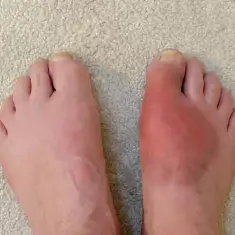
This is a significant mechanistic finding because it means PBM can increase NO production specifically in oxygen-depleted tissue — exactly the environment found in an acutely inflamed, swollen joint. During a gout flare, edema compresses local blood vessels, reducing oxygen delivery and creating tissue hypoxia. Under these conditions, CCO’s nitrite reductase function becomes more active, and PBM — by providing photon energy to CCO — may enhance this conversion further.
The result is a self-amplifying therapeutic loop in the tissues that need it most: the more hypoxic the tissue, the more active CCO’s nitrite reductase function becomes, and the more NO is produced for vasodilation. This vasodilation then improves oxygen delivery, gradually resolving the hypoxia. PBM accelerates this loop by providing the photon energy that drives CCO activity.
Published in Discovery Medicine, this paper reframed CCO from a simple photon absorber into a multifunctional enzyme with therapeutic relevance beyond ATP production.
G.O.A.T. for Gout Alignment:
The G.O.A.T.’s wavelengths target CCO — the same enzyme that acts as nitrite reductase under hypoxia. In a swollen, hypoxic MTP joint during a gout flare, this mechanism would be particularly active, potentially making PBM more effective precisely when it is most needed.
Link to original research here
Editor’s note: The NO photodissociation and eNOS pathways that complement this nitrite reductase function are reviewed in Keszler et al 2023. The human in vivo NO measurement confirming deep tissue release is in Barolet et al 2024. The CCO mechanisms paper that covers this enzyme’s full range of PBM-relevant functions is de Freitas & Hamblin 2016. The clinical capillary flow improvement that results from NO-mediated vasodilation is demonstrated in Gavish et al 2020.
Related Articles
- PBM and Nitric Oxide Signaling – Keszler et al 2023
- In Vivo NO Release from Human Skin Post PBM – Barolet et al 2024
- Proposed Mechanisms of PBM – de Freitas & Hamblin 2016
- Microcirculatory Response to PBM: RCT – Gavish et al 2020
- NIR PBM Augments NO via eNOS Phosphorylation – Yokomizo et al 2022
Key Takeaways
- CCO functions as a nitrite reductase — converting nitrite into NO, especially under hypoxia
- Hypoxic tissue = more active NO production — gout flares create exactly this environment
- Self-amplifying loop: NO → vasodilation → oxygen delivery → hypoxia resolution
- PBM is potentially most effective in the tissue state (hypoxic, inflamed) where it is most needed
Study Overview
| Study Type: | Mechanistic review |
| Wavelength(s): | Red + NIR (LED) |
| Treatment Protocol: | Mechanistic analysis |
| Sample Size: | Review |
| Primary Outcome: | CCO nitrite reductase function enhanced by PBM under hypoxic conditions |
Full Citation
Poyton RO, Ball KA. (2011). Therapeutic photobiomodulation: nitric oxide and a novel function of mitochondrial cytochrome c oxidase. Discovery Medicine, 11(57), 154–159. View Publication