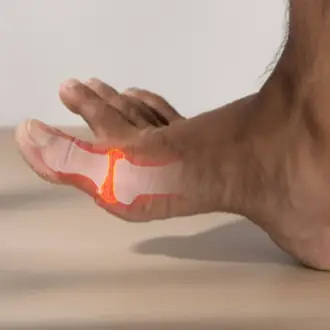
Condition Focus: Gout Arthritis — NLRP3 Pathogenesis and Therapeutic Strategies
This 2023 review in Frontiers in Immunology provides the most current and comprehensive analysis of how the NLRP3 inflammasome drives gout, with a specific focus on the upstream signals that prime and activate the complex — and the therapeutic strategies being developed to interrupt this cascade.
The review details a two-step activation model. First, NF-κB priming: pro-inflammatory signals upregulate NLRP3 and pro-IL-1β gene expression, loading the cell with the components needed for an inflammatory response. Second, activation: danger signals — primarily reactive oxygen species (ROS) from mitochondria, along with NEK7 protein interaction and post-translational modifications — trigger the actual assembly of the inflammasome complex.
The ROS connection is central to understanding why photobiomodulation may interrupt this cascade. The review identifies mitochondrial ROS as a key activating signal for NLRP3 in gout. PBM acts on mitochondria through cytochrome c oxidase absorption, and in inflamed or stressed cells, it has been shown to reduce rather than increase ROS output — potentially dampening the very signal that triggers inflammasome assembly.
The review also examines autophagy regulation as a negative feedback mechanism: cells use autophagy to disassemble activated inflammasomes and clear damaged mitochondria (mitophagy). Disruptions in autophagy contribute to sustained NLRP3 activation. PBM has been shown to enhance autophagic processes in some cell types, though this connection to gout specifically has not yet been directly studied.
G.O.A.T. for Gout Alignment:
The two-step NLRP3 activation model mapped here includes targets that PBM addresses: NF-κB priming (PBM suppresses NF-κB in inflamed tissues) and ROS-mediated activation (PBM reduces mitochondrial ROS in stressed cells). The G.O.A.T.’s 660 nm + 850 nm wavelengths target cytochrome c oxidase, modulating the mitochondrial function upstream of both signals.
Link to original research here
Editor’s note: The NF-κB priming pathway discussed here is directly addressed by PBM in Chen et al 2011, which demonstrated NF-κB modulation via mitochondrial ROS at 810 nm. The ROS-NLRP3 axis through the TXNIP pathway is detailed in Kim et al 2023. For the pre-crystallisation ROS-NLRP3 activation via soluble urate, see Braga et al 2017. PBM’s immunomodulatory effects including NF-κB suppression are comprehensively reviewed in Immunomodulatory Effects of PBM 2025.
Related Articles
- MSU Crystals Activate the NALP3 Inflammasome – Martinon et al 2006
- PBM Activates NF-κB via Mitochondrial ROS at 810nm – Chen et al 2011
- Mechanism of NLRP3 Inflammasome Activation in Gout – Kim et al 2023
- Soluble Uric Acid Activates the NLRP3 Inflammasome – Braga et al 2017
- Immunomodulatory Effects of PBM: Comprehensive Review – 2025
Key Takeaways
- Two-step NLRP3 activation: NF-κB priming + ROS-mediated assembly — PBM targets both
- Mitochondrial ROS is identified as the key activating signal for NLRP3 in gout
- Autophagy dysfunction sustains inflammasome activation — PBM may enhance autophagic clearance
- Most current (2023) and comprehensive review of NLRP3 in gout pathogenesis
Study Overview
| Study Type: | Review |
| Wavelength(s): | N/A (disease mechanism and therapeutic strategy review) |
| Treatment Protocol: | N/A — maps activation signals and therapeutic targets |
| Sample Size: | Review of NLRP3 gout literature |
| Primary Outcome: | ROS-mediated two-step NLRP3 activation model with therapeutic target mapping |
Full Citation
Jin Y, et al. (2023). Role of NLRP3 in the pathogenesis and treatment of gout arthritis. Frontiers in Immunology, 14, 1137822. View Publication