Condition Focus: Acute Inflammatory Edema — Novel Cannabinoid Receptor Pathway
Most studies on PBM’s anti-inflammatory mechanisms focus on familiar pathways — NF-κB, cytokine suppression, macrophage polarization. This study from Neves and colleagues broke new ground by identifying an entirely unexpected mechanism: PBM reduces acute edema through activation of cannabinoid receptors CB1 and CB2.
Using 660 nm PBM at 50 J/cm² in a carrageenan-induced paw edema model, the researchers demonstrated significant edema reduction accompanied by IL-6 decrease and IL-10 increase. But the critical experiment was the antagonist confirmation: when specific CB1 and CB2 receptor blockers were administered before PBM treatment, the anti-edema effect was abolished. This proves the effect is mediated through cannabinoid receptors, not through general anti-inflammatory pathways.
The study also identified ATP-sensitive potassium (KATP) channels and p38-MAPK signalling as downstream components of this pathway, mapping a complete signal transduction chain from photon absorption to edema reduction through a cannabinoid-mediated mechanism.
This is significant for two reasons. First, it reveals that PBM’s anti-inflammatory toolkit is broader than previously understood — it does not rely on a single mechanism but engages multiple independent pathways, each capable of reducing inflammation through different cellular programmes. Second, the endocannabinoid system is known to play important roles in pain modulation and inflammatory resolution, adding another dimension to PBM’s potential benefit in conditions like gout where both pain and inflammation are primary concerns.
G.O.A.T. for Gout Alignment:
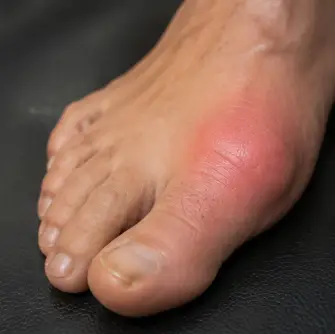
The G.O.A.T.’s 660 nm wavelength is identical to that used in this study. The cannabinoid receptor pathway provides an additional mechanism through which the device may reduce MTP joint edema during gout flares — independent of the NF-κB and macrophage pathways also supported at this wavelength.
Link to original research here
Editor’s note: This entirely novel mechanism adds to the multi-pathway anti-edema evidence. The COX-2/PGE₂ pathway at 660 nm is demonstrated in Albertini et al 2007. The macrophage-mediated resolution pathway at 660 nm is shown in Fernandes et al 2019. The wavelength-dependent edema response across red and NIR is reviewed in Fonseca et al 2025. For the bioimpedance-measured clinical edema reduction, see Chia et al 2025.
Related Articles
- Anti-Inflammatory Effect of PBM on COX-2 and PGE₂ in Joint Inflammation – Albertini et al 2007
- Wavelength and Timing in PBM-Induced Macrophage Polarization – Fernandes et al 2019
- PBM on RA and OA: Edema and Vascular Permeability – Fonseca et al 2025
- PBM on Swelling Reduction and Recovery in TKA – Chia et al 2025
- PBM Inhibits TMJ Inflammation and Reduces Edema – 2021
Key Takeaways
- 660 nm PBM reduces acute edema through CB1/CB2 cannabinoid receptor activation — entirely novel pathway
- Antagonist-confirmed: blocking CB1/CB2 abolished the anti-edema effect
- Complete signal chain mapped: CB1/CB2 → KATP channels → p38-MAPK → edema reduction
- Endocannabinoid system involvement adds pain modulation dimension beyond anti-inflammatory effects
Study Overview
| Study Type: | Controlled animal study (mechanistic) |
| Wavelength(s): | 660 nm |
| Treatment Protocol: | 30 mW, 50 J/cm², single plantar application; carrageenan-induced paw edema |
| Sample Size: | Mouse groups with CB1/CB2 antagonists as controls |
| Primary Outcome: | Edema↓ via CB1/CB2; IL-6↓; IL-10↑; antagonist-confirmed mechanism |
Full Citation
Neves LMS, Gonçalves ECD, Cavalli J, et al. (2018). Photobiomodulation therapy improves acute inflammatory response in mice: the role of cannabinoid receptors/ATP-sensitive K⁺ channel/p38-MAPK signalling pathway. Molecular Neurobiology, 55(7), 5580–5593. View Publication</a