Condition Focus: Vascular Function — Nitric Oxide-Mediated Vasodilation and Tissue Perfusion
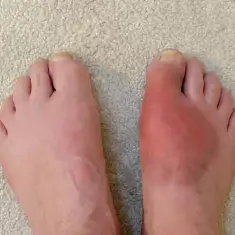
Nitric oxide (NO) is the body’s primary vasodilator — a signalling molecule that relaxes blood vessel walls, increases blood flow, and improves tissue perfusion. In a gouty joint, adequate blood flow is critical for two reasons: delivering oxygen and nutrients for tissue repair, and removing inflammatory waste products and dissolved urate from the joint space.
This mechanistic review from Keszler and colleagues in Nitric Oxide (Elsevier) maps the pathways through which PBM increases NO bioavailability. Two primary mechanisms are identified. First, NO photodissociation: light at red and NIR wavelengths breaks the bond between NO and cytochrome c oxidase (CCO) in the mitochondrial electron transport chain, releasing free NO that diffuses to surrounding blood vessels and triggers vasodilation. Second, eNOS activation: PBM phosphorylates endothelial nitric oxide synthase (eNOS) via the Akt signalling pathway, stimulating the production of new NO by the cells lining blood vessel walls.
The review also describes CCO’s nitrite reductase function — the enzyme can convert nitrite into NO, particularly in hypoxic (low oxygen) conditions. This is directly relevant to gout because inflamed, swollen joints are hypoxic: the edema compresses blood vessels and reduces oxygen delivery, creating exactly the conditions where CCO’s nitrite reductase activity is most active.
G.O.A.T. for Gout Alignment:
The G.O.A.T.’s 850 nm wavelength falls within the NIR range shown to photodissociate NO from CCO and activate eNOS. The vasodilation and perfusion improvement described here supports the G.O.A.T.’s role in enhancing blood flow to the inflamed MTP joint — facilitating both nutrient delivery for repair and waste clearance for flare resolution.
Link to original research here
Editor’s note: The eNOS/Akt pathway described here is confirmed at the molecular level in Yokomizo et al 2022. The first direct in vivo human measurement of NO release is reported in Barolet et al 2024. The CCO nitrite reductase function under hypoxia is explored in Poyton & Ball 2011. For the clinical capillary flow evidence, see Gavish et al 2020.
Related Articles
- NIR PBM Augments NO via eNOS Phosphorylation – Yokomizo et al 2022
- In Vivo NO Release from Human Skin Post PBM – Barolet et al 2024
- CCO as Nitrite Reductase: Novel PBM Function – Poyton & Ball 2011
- Microcirculatory Response to PBM: RCT – Gavish et al 2020
- PBM Stimulates Lymphatic Contractility and Flow – 2020
Key Takeaways
- PBM increases NO through two pathways: photodissociation from CCO + eNOS/Akt activation
- CCO acts as nitrite reductase under hypoxic conditions — gout joints are hypoxic from edema
- Increased NO → vasodilation → improved joint perfusion → better waste and urate clearance
- Dose-dependent NO release supports specific parameter selection
Study Overview
| Study Type: | Mechanistic review |
| Wavelength(s): | NIR-I (808 nm); NIR-II (1064, 1270 nm) |
| Treatment Protocol: | Varies across reviewed studies |
| Sample Size: | Review of NO signalling studies |
| Primary Outcome: | Dose-dependent NO increase for vasodilation and tissue perfusion |
Full Citation
Keszler A, et al. (2023). Photobiomodulation and nitric oxide signaling. Nitric Oxide, 131, 58–68. View Publication