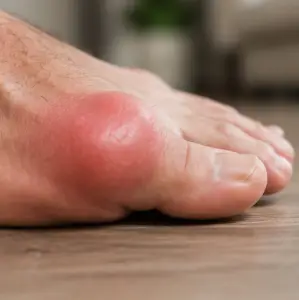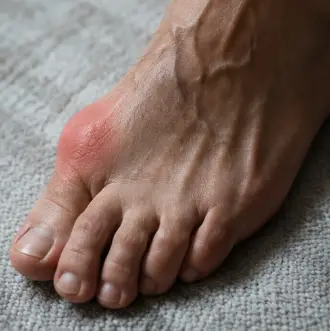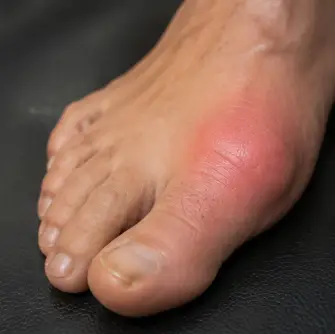
Condition Focus: Acute Gouty Arthritis, Calcium Pyrophosphate Deposition Disease (CPPD), Hydroxyapatite Arthropathy
This is arguably the most important study in the G.O.A.T. for Gout research library. Soriano and colleagues at the Universidad Nacional de Córdoba designed a two-part investigation — first testing laser therapy against crystal-induced joint inflammation in rats, then translating those results directly into a randomized clinical trial in human patients with three different types of crystal arthropathy, including acute gout.
In the animal arm, monosodium urate (MSU), calcium pyrophosphate, and hydroxyapatite crystals were injected into rat joints. The groups treated with laser irradiation showed significant reductions in three key inflammatory markers — fibrinogen, prostaglandin E₂ (PGE₂), and TNF-α — compared to untreated controls. These are not obscure laboratory endpoints: PGE₂ is the exact molecule that NSAIDs like diclofenac and indomethacin are designed to suppress, and TNF-α is one of the primary drivers of the inflammatory cascade that makes a gout flare so painful.
The clinical arm enrolled 104 patients across three crystal arthropathy groups: 25 with acute gouty arthritis, 49 with chronic calcium pyrophosphate arthropathy, and 30 with chronic hydroxyapatite deposition disease. Patients were randomized to receive either laser therapy or diclofenac. In acute gout, laser therapy achieved rapid pain relief with no significant difference in efficacy compared to diclofenac at 75 mg twice daily — the standard first-line NSAID dose. In chronic pyrophosphate and apatite disease, laser therapy was actually more effective than diclofenac at 50 mg twice daily over a 21-day treatment course.
The implication is direct: photobiomodulation produced equivalent or superior outcomes to the most commonly prescribed NSAID for crystal arthropathies, with none of the gastrointestinal, renal, or cardiovascular side effects that make long-term NSAID use problematic — particularly in the older patients who are most affected by gout.
G.O.A.T. for Gout Alignment:
This study establishes the clinical foundation for PBM in crystal-induced joint disease. The G.O.A.T. delivers 660 nm and 850 nm wavelengths at ~5 mW/cm² irradiance targeting 4 J/cm² fluence — parameters within the therapeutic window demonstrated across the broader PBM evidence base. The inflammatory markers reduced in this study (PGE₂, TNF-α, fibrinogen) are the same mediators that drive acute gout flare pain and swelling, and they are the same targets addressed by the G.O.A.T.’s dual-wavelength design through mitochondrial and anti-inflammatory pathways.
Link to original research here
Editor’s note: Soriano 2006 remains the only published randomized trial directly comparing PBM to NSAIDs in acute gout. For the preclinical gout model using combined LASER + LED on dorsal root ganglia, see Pinto et al 2023. A second clinical comparison of infrared therapy versus NSAIDs in acute gout is reported in Zhu et al 2011. The PGE₂ and COX-2 suppression mechanism demonstrated here is explored at the tissue level in Albertini et al 2007, and the complete four-cytokine inflammatory panel (IL-1β, IL-6, TNF-α, PGE₂) is confirmed in a joint model by Tomazoni et al 2017. For evidence that PBM reduces joint inflammation through synoviocyte-specific pathways, see Ryu et al 2023.
Related Articles
- Acute Effects of PBM Applied on DRG in Gout Model-Induced Rats – Pinto et al 2023
- Acupuncture Combined with Infrared Irradiation for Acute Gouty Arthritis – Zhu et al 2011
- Anti-Inflammatory Effect of PBM on COX-2 and PGE₂ in Joint Inflammation – Albertini et al 2007
- Effects of PBM on Inflammatory Response in Experimental Osteoarthritis – Tomazoni et al 2017
- PBM Ameliorates Inflammatory Parameters in Fibroblast-Like Synoviocytes – Ryu et al 2023
- PBM Improves Acute Inflammation via Cannabinoid Receptor Activation – Neves et al 2018
Key Takeaways
- Laser therapy matched diclofenac for pain relief in acute gouty arthritis with no significant difference in efficacy
- PBM outperformed diclofenac in chronic calcium pyrophosphate and hydroxyapatite arthropathies over 21 days
- Inflammatory markers PGE₂, TNF-α, and fibrinogen were significantly reduced in the laser-treated animal model
- PGE₂ suppression confirms PBM engages the same COX pathway targeted by NSAIDs — without the side effects
- 104 human patients enrolled across three crystal arthropathy types, including 25 with acute gout
Study Overview
| Study Type: | Randomized clinical trial (human) + controlled animal study |
| Wavelength(s): | Laser (specific wavelength not reported in abstract) |
| Treatment Protocol: | Acute: 5-day course; Chronic: 21-day course; daily sessions |
| Sample Size: | Human: 104 patients (25 gout, 49 CPPD, 30 apatite); Animal: 3 groups of rats |
| Primary Outcome: | Pain relief equivalence vs. diclofenac; reduction of PGE₂, TNF-α, fibrinogen |
Full Citation
Soriano F, Campana V, Moya M, Gavotto A, Simes J, Soriano M, Soriano R, Spitale L, Palma J. (2006). Photobiomodulation of pain and inflammation in microcrystalline arthropathies: experimental and clinical results. Photomedicine and Laser Surgery, 24(2), 140–150. View Publication