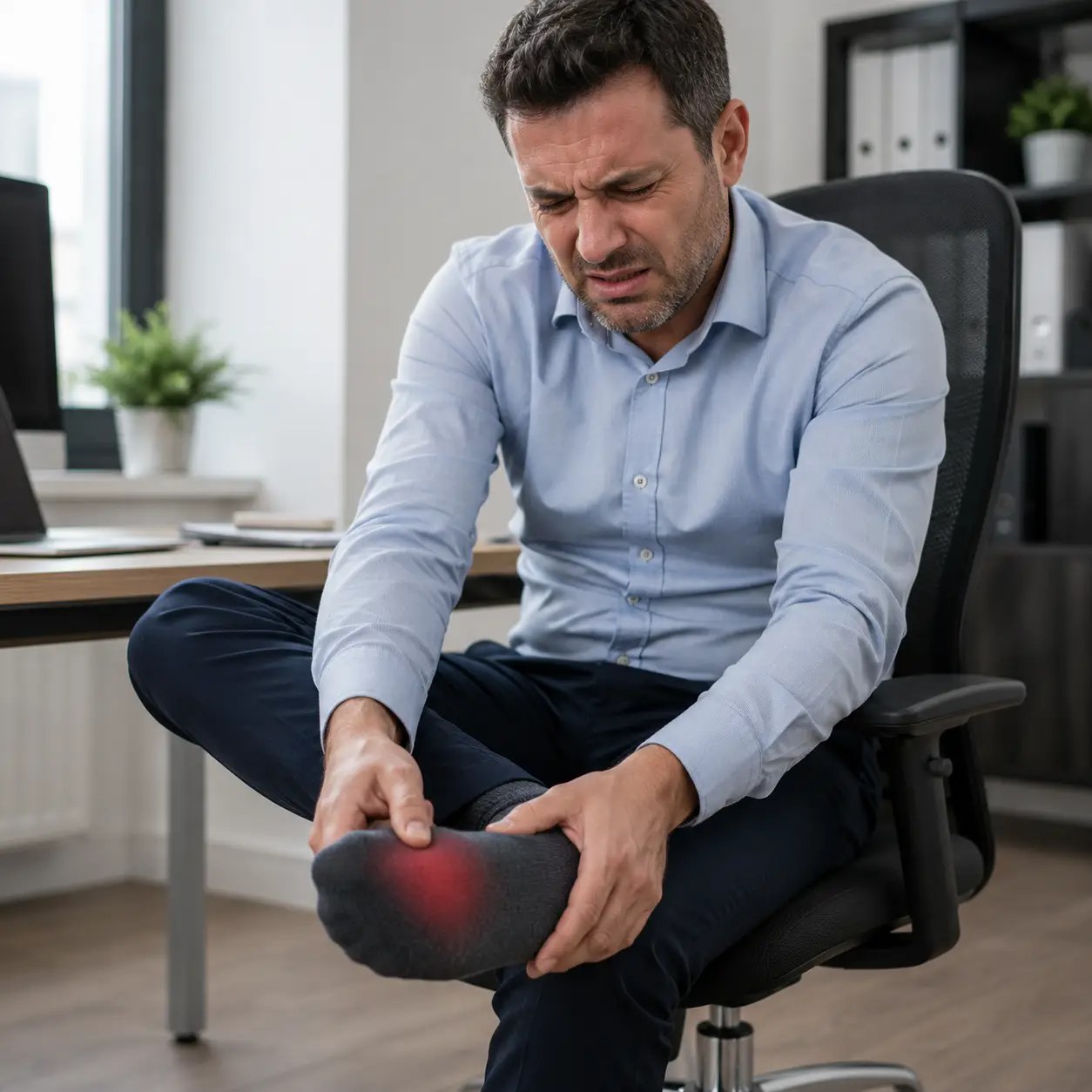
Condition Focus: Knee Osteoarthritis — Pain and Disability Outcomes
When evaluating whether a therapy works, the gold standard is a meta-analysis of placebo-controlled randomized trials — and that is exactly what Oliveira and colleagues delivered in this 2024 publication in Physical Therapy, one of the premier rehabilitation science journals. By pooling data across multiple RCTs where patients received either real PBM or sham (placebo) devices, this analysis provides the most statistically robust answer available to the question: does photobiomodulation actually reduce joint pain?
The answer is yes. The meta-analysis confirmed that PBM significantly reduces both pain and disability in knee osteoarthritis compared to sham treatment. Because every included trial used a placebo control — meaning patients did not know whether they were receiving real or fake light therapy — these results cannot be explained by placebo effect alone.
This matters for gout because the inflammatory pain pathways in OA and gout share significant overlap. Both conditions involve IL-1β-driven inflammation, prostaglandin-mediated pain sensitisation, and progressive joint damage. While the triggers differ (mechanical wear in OA versus urate crystal deposition in gout), the downstream inflammatory cascade and the tissue structures affected — cartilage, synovium, subchondral bone — are the same. Evidence that PBM reliably reduces pain in one inflammatory joint condition strengthens the rationale for its application in the other.
G.O.A.T. for Gout Alignment:
The wavelengths and energy densities used across the trials in this meta-analysis encompass the G.O.A.T.’s 660 nm + 850 nm output at 5 mW/cm². The consistent pain reduction demonstrated here supports the G.O.A.T.’s positioning as a non-pharmacological pain management tool for inflammatory joint disease.
Link to original research here
Editor’s note: This meta-analysis provides the highest level of evidence for PBM’s pain-relieving effects in joint disease. For the specific mechanisms driving these outcomes, see the cytokine suppression data in Tomazoni et al 2017 and the oxidative stress reduction pathway in Yamada et al 2020. The cartilage-protective effects that may underlie disability improvements are demonstrated in Balbinot et al 2021. A broader musculoskeletal meta-analysis with similar findings is reported by Clijsen et al 2017.
Related Articles
- Current Advances of PBM in Treating Knee Osteoarthritis – 2023
- Effects of PBM on OA from In Vivo and In Vitro Studies – Narrative Review 2025
- PBM for Musculoskeletal Disorders and OA with NSAID Comparison – 2019
- PBM Restores Cartilage Integrity and Reduces Chronic Pain in OA – Balbinot et al 2021
- PBM Reduces Oxidative Stress and Inflammation in Knee OA – Yamada et al 2020
Key Takeaways
- Placebo-controlled meta-analysis confirms PBM reduces both pain and disability in knee OA
- Results cannot be attributed to placebo effect — all included trials used sham controls
- Published in Physical Therapy (Oxford Academic), a premier rehabilitation journal
- OA and gout share inflammatory pain pathways (IL-1β, prostaglandins, synovial inflammation)
Study Overview
| Study Type: | Systematic review with meta-analysis of RCTs |
| Wavelength(s): | Multiple (across included trials) |
| Treatment Protocol: | Varies across included trials |
| Sample Size: | Multiple placebo-controlled RCTs pooled |
| Primary Outcome: | Significant reduction in pain and disability vs. sham PBM |
Full Citation
Oliveira S, et al. (2024). Effectiveness of photobiomodulation in reducing pain and disability in knee osteoarthritis: a systematic review with meta-analysis. Physical Therapy, 104(8), pzae073. View Publication