Condition Focus: Mitochondrial Redox Signaling — Context-Dependent ROS Modulation
A common criticism of PBM is: “How can one intervention both increase and decrease ROS?” This 2018 paper from Hamblin in Photochemistry and Photobiology resolves the paradox by demonstrating that PBM’s effect on reactive oxygen species is context-dependent — determined by the baseline oxidative state of the target cell.
In healthy, quiescent cells with normal mitochondrial function, PBM produces a brief, mild increase in ROS. This small ROS burst acts as a signalling event, activating adaptive stress responses (Nrf2, antioxidant enzymes, heat shock proteins) that leave the cell more resilient than before — the cellular equivalent of a vaccination.
In oxidatively stressed or inflamed cells — where ROS levels are already pathologically elevated — PBM reduces ROS. The mechanism involves optimisation of the mitochondrial electron transport chain: by providing photon energy to CCO and releasing the NO inhibitory block, PBM allows electrons to flow more efficiently through the chain rather than leaking to form superoxide radicals. The result is less ROS production per unit of oxygen consumed.
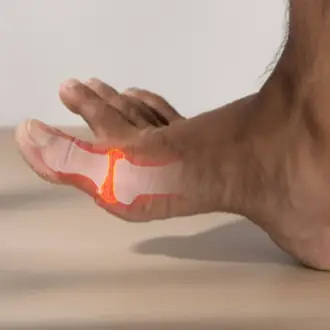
This context-dependence is critical for gout because a gouty joint is a high-ROS environment. MSU crystal phagocytosis generates mitochondrial ROS (the signal that activates NLRP3), and the resulting inflammation produces further oxidative stress. In this environment, PBM would be expected to reduce ROS — exactly the response needed to interrupt the NLRP3 activation cascade.
The paper also discusses mitochondrial membrane potential (MMP) as a universal marker of PBM effect: MMP increases in all cell types regardless of baseline state, confirming that PBM consistently enhances mitochondrial function even when its ROS effects are directionally opposite.
G.O.A.T. for Gout Alignment:
The G.O.A.T. targets inflamed, oxidatively stressed tissue — exactly the environment where this paper predicts PBM will reduce ROS. The 810 nm data reviewed here (close to the G.O.A.T.’s 850 nm) confirms that NIR wavelengths are particularly effective at mitochondrial ROS modulation.
Link to original research here
Editor’s note: The ROS-NLRP3 connection in gout — where the ROS reduction described here would interrupt inflammasome assembly — is detailed in Kim et al 2023 and Braga et al 2017. The biphasic dose pattern underlying these context-dependent effects is defined in Huang et al 2009. The oxidative stress reduction in a knee OA model is demonstrated in Yamada et al 2020. The hormetic mitochondrial response is explored in PBM and Oxidative Stress 2022.
Related Articles
- Mechanism of NLRP3 Inflammasome Activation in Gout – Kim et al 2023
- Soluble Uric Acid Activates the NLRP3 Inflammasome – Braga et al 2017
- Biphasic Dose Response in PBM: Arndt-Schulz Curve – Huang et al 2009
- PBM Reduces Oxidative Stress and Inflammation in Knee OA – Yamada et al 2020
- PBM and Oxidative Stress: Mitochondrial Activity Regulation – 2022
Key Takeaways
- PBM reduces ROS in stressed/inflamed cells — increases ROS only in healthy cells
- Context-dependent: the baseline oxidative state determines the direction of the effect
- Gouty joints are high-ROS environments — PBM would reduce ROS where it matters most
- MMP increases universally — consistent mitochondrial function enhancement
Study Overview
| Study Type: | Mechanistic review |
| Wavelength(s): | 810 nm (primary); Red + NIR reviewed |
| Treatment Protocol: | 0.03–30 J/cm²; peak ~3 J/cm² |
| Sample Size: | Review of mitochondrial redox studies |
| Primary Outcome: | ROS↓ in stressed cells; ROS mild↑ in healthy cells; MMP↑ universal |
Full Citation
Hamblin MR. (2018). Mechanisms and mitochondrial redox signaling in photobiomodulation. Photochemistry and Photobiology, 94(2), 199–212. View Publication